Research
Understanding enzyme catalysis, predicting and engineering enzyme function, and applying frontier methods toward sustainable chemistry and human health.
Enzymes achieve extraordinary catalytic efficiency through the precise organization of their protein scaffolds — arranging charges, dynamics, and electronic interactions to stabilize transition states and direct reaction outcomes. My research investigates the physical principles that underpin this control and translates them into strategies for discovering novel reactivity, predicting catalytic function, and designing enzymes with tailored properties.
This program is organized around three interconnected questions: Why do enzymes catalyze specific reactions with such precision? How can we predict and engineer catalytic function? And what for — how can these insights drive real-world applications in health, energy, and sustainability?
Understanding Enzyme Catalysis
Why do enzymes catalyze specific reactions with extraordinary selectivity?
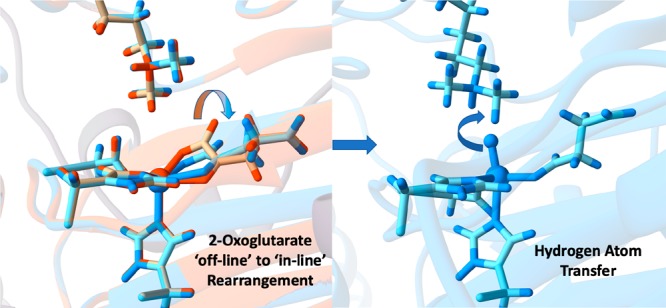
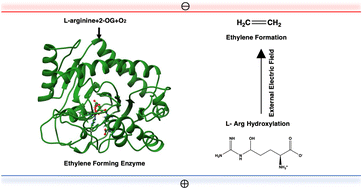
I investigate the physical principles by which protein scaffolds control catalytic outcomes using hybrid QM/MM simulations (DFT, DLPNO-CCSD(T)), microsecond-scale molecular dynamics, and dynamic 3D electric field mapping. A central focus has been the non-heme iron/2OG enzyme superfamily — where I have uncovered how coordination dynamics, substrate reorientation, and second coordination sphere interactions drive catalytic diversity, including predicting a novel bicarbonate intermediate validated in Science (2021). I have mapped three-dimensional electric fields within active sites as quantitative descriptors of catalytic potential, revealing latent compatibility with non-native functions — a physical basis for evolving new chemistry. Using microsecond MD, I characterized allosteric communication pathways and correlated motions that modulate catalysis far from the active site, and developed validated force field parameters for metalloenzyme simulations.
Key publications
- ACS Catal. 2020, 10, 1195–1209 (Iron center rearrangement in histone demethylase PHF8)
- ACS Catal. 2021, 11, 1578–1592 (Ethylene-forming enzyme: novel pathway validated in Science)
- JACS Au 2022, 2, 2169–2186 (Second coordination sphere modulation in histone demethylase)
- ACS Central Science 2020, 6, 795–814 (Selectivity in DNA repair oxygenases)
- Chem. Eur. J. 2023, 29, e202300138 (Protein environment controls dioxygen binding in non-heme iron enzymes)
- Chem Catalysis 2023, 3, 100732 (Catalytic strategy of the FTO obesity enzyme)
- Inorg. Chem. 2024, 63, 10737–10755 (Second coordination sphere control in KDM2A)
- Phys. Chem. Chem. Phys. 2023, 25, 13772–13783 (External electric field control of reactivity)
- Chem. Sci. 2020, 11, 9950–9961 (Substrate dynamics and correlated motions in KDM4A)
- Chem. Eur. J. 2019, 25, 5422–5426 (Conformational dynamics in KDM7 demethylases)
Predicting & Engineering Enzyme Function
How can we predict catalytic function and design enzymes with new capabilities?
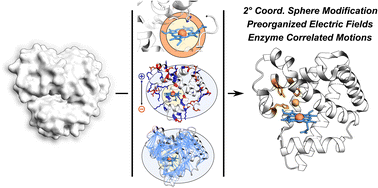
I develop computational methods, open-source software, and machine learning approaches that translate mechanistic understanding into predictive power and enzyme design. Applying ML to electric field fingerprints, I showed that models can classify enzymatic function with up to 84% accuracy — revealing electrostatic signatures as the physical basis of functional divergence across enzyme families and enabling the prediction of evolutionary starting points for new reactivity. This work led to PyCPET, an open-source toolbox for computing heterogeneous 3D protein electric fields, integrating MD, topological analysis, and QM/MM into a unified pipeline. I demonstrated that directed evolution optimizes the enzyme’s electric field — not just individual residues — in protoglobin’s non-native cyclopropanation activity, establishing the second coordination sphere as a powerful lever for rational design. My long-term vision is inverse enzyme design: starting from a desired catalytic outcome, identifying the optimal electric field, and using ML with AlphaFold/diffusion models to generate scaffolds that produce that field — shifting from sequence-first to field-first design.
Key publications
- Chem. Rev. 2025, 125, 3772–3813 (Comprehensive review: methods for local fields in enzymes)
- J. Am. Chem. Soc. 2025, 147, 32225–32237 (Distinct EFs enable common function across enzyme families)
- J. Am. Chem. Soc. 2024, 146, 28375–28383 (ML prediction of enzyme function from electric fields)
- J. Am. Chem. Soc. 2024, 146, 16670–16680 (Electric field optimization in directed evolution)
- J. Chem. Theory Comput. 2025, 21, 4299–4308 (PyCPET: open-source EF software)
- Chemical Science 2023, 14, 10997–11011 (From random to rational enzyme design)
Frontier Applications
What for — how can these insights drive real-world impact?
At ETH Zürich, as part of an XPRIZE finalist team, I am developing high-performance pipelines for biological applications on quantum computers — tackling strongly correlated metal centers intractable by classical methods. I apply electric field-guided and second coordination sphere engineering to heme and non-heme metalloenzymes, including cytochrome P450 variants for selective transformations and the catalytic mechanism of nitrogenase for sustainable nitrogen fixation. I also contribute to artificial metalloenzyme design for CO2 capture and conversion, extending mechanistic insights to engineered catalysts for green chemistry. In drug discovery, I apply free energy perturbation simulations to characterize inhibitor binding to α-synuclein aggregation targets in Parkinson’s disease.
Recent outputs & ongoing collaborations
- ChemRxiv 2025 (Artificial metalloenzyme for Re(I)-catalyzed CO2 photoreduction; with Yang group, UC Irvine, and Rovis group, Columbia)
- Cytochrome P450 engineering for selective C–H functionalisation (ongoing; with Ward group, University of Basel)
- Quantum-computing pipelines for biological metal centers (ongoing; XPRIZE finalist team, ETH Zürich)
- Nitrogenase catalytic mechanism (ongoing; NITRO-GENESE consortium)